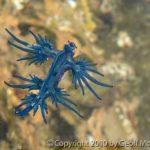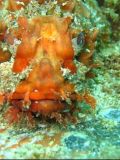
Scorpion Fish, Costa Rica
October 28th, 2012
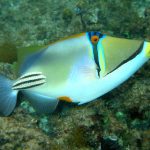
The Pacific Ocean is host to a variety of different scorpion[...]

Costa Rica's Scuba Diving Portal: Everything you want to know about Diving in Costa Rica
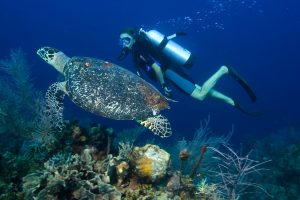
Aside from sharks, manta rays, whales and schools of fish, what comes in to your mind if you think about the dive sites of Costa Rica are Sea Turtles. Diving in Catalina Island, Bat Island, Cocos Island, Cabo Velas, Cano Island and other major sites has a high chance of seeing a sea turtle. We know that sea turtles are the cousins of land turtles and that they have a pair of flippers instead of legs that usually have sharp claws. But can we really distinguish the name and appearance of the different kinds of sea turtles?
Costa Rica houses 4 species of sea turtles, namely: leatherback, green, hawksbill and olive ridley. For a layman’s eye, all of them are just sea turtles. But with the keen eye of a diver like you, each species has a distinctive characteristic that is unique to its own. Together with its description, may we present to you the sea turtles that you can find in Costa Rica.
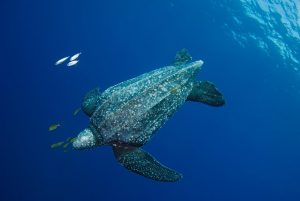 You can easily identify this turtle due to the absence of a hard and bony shell or carapace giving you this leathery texture. This 4th heaviest member of the reptilian family that weighs 500 kilograms on the average has a large pair of front flippers that can grow up to 2 meters in length. Upon reaching maturity, a full-sized body of a leather back sea turtle that is colored black can reach up to 2.5 meters in length which had earned its title as the largest turtle in the world. They are also the fastest swimming sea turtle that can boost up to 35 km/hr. So, if you want to observe and spend more time with this gentle giant, try to avoid jerky or any unnecessary movement that may startle the animal as they only travel 1 km/hr when not threatened.
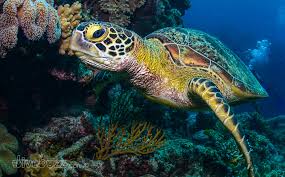 No, the body nor the carapace is not colored green and this is not the basis of naming this sea turtle. The word green only represents the color of the fat that is found beneath the carapace.
In identifying this sea turtle, you need to look for the snout that is very short with an unhooked beak. While other sea turtles can protrude their heads, the neck of the green sea turtle cannot be pulled out of its carapace thereby giving you an impression that its head is stuck on its shell. Another identifying mark for a green sea turtle is there is a solitary claw in each of the frontal flippers and this is very prominent if the animal is an adult.
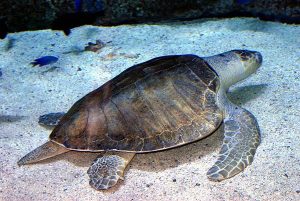 This medium-sized sea turtle measuring 70 cm in length and weighing 50 kilograms on the average, can easily be identified with its heart-shaped carapace. Similar with green sea turtles, they too have claws in the frontal flippers. But in the case of Olive Ridleys, they have two claws in each frontal flipper and are more pronounced in males which they used during mating. It has a broad head that tapers down going to the neck that when you look it from above, it looks like a triangle.
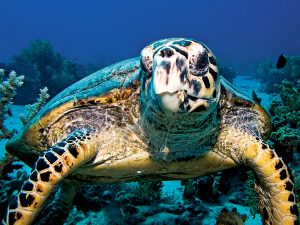 Do you want an easy identifying mark for this particular sea turtle? Forget the color of the body and carapace or the size and shape of the head, although you are already near. Just look at the beak. If the beak looks something like an eagle or perhaps a parrot (in case you haven’t seen an eagle’s beak), then that turtle is definitely a Hawksbill.
Hawksbill sea turtles can easily be distinguished from its sharp and curved beak where the tomium is highly prominent. They can grow up to 1 meter in length and weighs 80 kilograms on the average. If you happen to see this sea turtle during a night dive, we suggest you try turning off your flashlight or underwater torch for a few seconds. You will be amazed to observe that this turtle emits light due to its biofluorescent characteristics.
Now that we know that there are several species of sea turtles in Costa Rica, you may now wonder why despite considered as an endangered species, sea turtle abounds in this Central American region. The answer lies in its remote islands where these sea turtles come back each year to lay their eggs.
video courtesy from Pura Vida House

Tristan Paylado
a.k.a. TRIX, is a Marine Biologist, CMAS 2 Star Dive Instructor and a proficient writer that thinks like an octopus but acts like an Orca.


October 28th, 2012
November 7th, 2012